
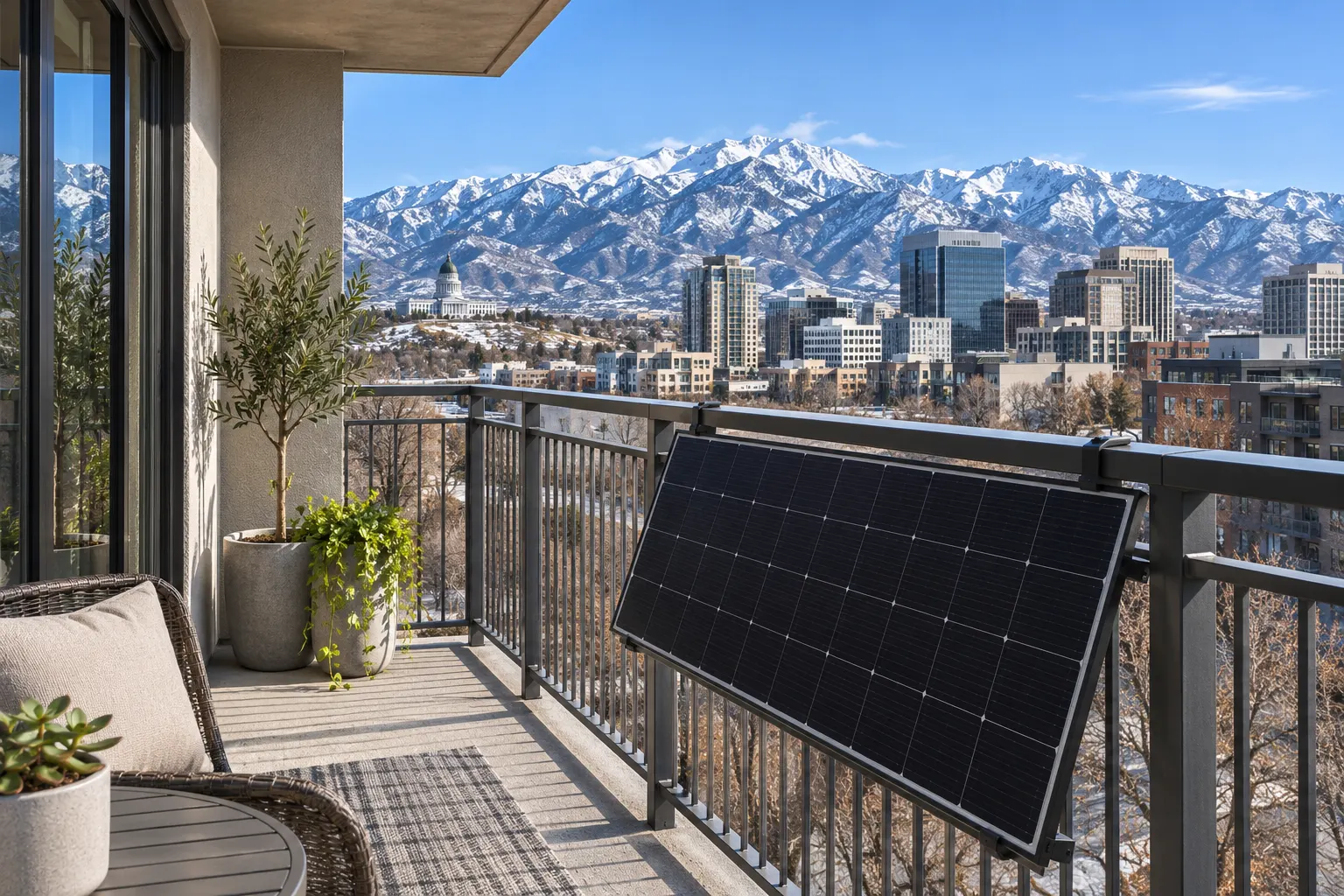
Plug in solar in Utah is legal under state law. House Bill 340 took effect on May 7, 2025 Utah HB 340 (2025) and lets you plug a small solar kit into a standard 120 V outlet, up to 1,200 W, without asking your utility for approval. This guide covers what the law says, what it leaves out, and what that means for savings, renters and buying a kit.
The Short Version
- Legal in Utah since May 7, 2025 Legal
- Cap: 1,200 W Utah HB 340 (2025)
- Your utility cannot require approval, a fee or extra equipment
- No notification required
- Kit must be UL or equivalent NRTL certified, with anti-islanding protection
- Surplus power is outside net metering, so exports are not paid for
What HB 340 Says
HB 340 (2025) is codified at Utah Code 54-15-601. Governor’s signature came on March 25, 2025 and it took effect on May 7, 2025. Utah HB 340 (2025), status It is a short law with a clear aim: a small plug-in kit should not be treated like a rooftop system that needs a utility application.
The 1,200 W Limit
The ceiling is 1,200 W. The kit must plug into a standard 120 V outlet, the same kind of socket that runs a lamp or a toaster. Utah HB 340 (2025)
In plain terms, that is a small system. It is meant to cover the electricity your home is already using while the sun shines, such as a fridge, a router and standby loads. It is not designed to run a whole house, and a bigger array does not push more into the law’s allowance.
Two practical points follow from the limit:
- Check the wattage printed on the inverter, not only the panel rating on the box. It is the output that counts toward the cap.
- If a listing is vague about output, ask the seller before you buy. A kit that cannot state its rated output is hard to match against the law.
Equipment Standards
HB 340 asks for three things from the equipment itself. It must be certified by UL or an equivalent nationally recognized testing laboratory (NRTL). It must have anti-islanding protection, meaning it stops feeding power when the grid is down so that line workers are not exposed. And it must meet the most recent edition of the National Electrical Code (NEC). Utah HB 340 (2025)
When you compare kits, look for the certification mark and the model number on the label or the datasheet, and for a plain statement of anti-islanding. A seller that cannot show either has not given you what the law asks for. Our US kit comparison lists what each brand says about its certification, with the date we checked.
What Your Utility Can’t Ask For
This is the part that makes the Utah law unusual. The utility cannot require you to get approval, cannot charge a fee for a qualifying system, and cannot demand extra equipment, such as an additional disconnect. You also do not have to notify it. Utah HB 340 (2025)
That is a different deal from the process rooftop solar customers go through, which usually means an application, an inspection and a wait. Under HB 340, none of that applies to a system that meets the law.
What the law does not do is override everything else. We read it for the utility and the equipment. We did not find in it any rule about leases or HOA covenants (more on that below), and we have not checked city rules on mounting or building permits. If you plan to bolt anything to a building, check locally first.
No Net Metering: What That Means for Savings
HB 340 puts plug-in systems outside net metering. Utah HB 340 (2025) Net metering is the arrangement where your utility credits you for power you send back to the grid. Without it, whatever your kit produces beyond what the home is using at that moment is not credited to your bill.
So the economics are simple. A plug-in kit saves you money when the house is using the power as it is made. Think of the always-on loads that run all day: refrigerator, internet gear, a computer, a dehumidifier. If someone is home during the day, more of the kit’s output gets used. If the house is empty from morning to evening, less is used, and some is sent to the grid for nothing.
That is not a reason to skip it. It is a reason to size your expectations to your own daytime use. Your figure depends on how much sun your spot gets, how much of your load is steady, and what you pay per kilowatt-hour. A rule of thumb will be wrong for many homes, which is why our calculator asks for your own inputs.
Renters and HOAs in Utah
HB 340 has no landlord or HOA provision. Utah HB 340 (2025) The law tells the utility what it cannot ask of you. It does not give tenants a right to install, and it does not stop a landlord or an association from saying no.
In practice, your lease and your community’s rules govern. We could not verify general Utah law on this point beyond HB 340, so do not assume the state law settles a dispute with a landlord or an HOA.
Here is what we would do if you rent or live under an HOA:
- Read your lease or covenants for clauses on alterations, exterior changes and electrical work.
- Ask in writing, describe the kit, and offer to remove it and restore the wall, railing or fence when you leave.
- Choose a setup that is easy to reverse, such as a free-standing frame or a rail mount, rather than anything drilled into the structure.
- Tell your insurer. We found nothing in the law that requires a particular policy, but it is a short call.
The landlord letter, the HOA note and the insurer note are the documents most renters end up writing. The renters’ pack has them ready to send.
Kits Sold for Utah
Because HB 340 asks for UL or NRTL certification, anti-islanding and a 1,200 W ceiling, the kits that fit are those with a rated output at or under 1,200 W, an outlet connection and the certification on the label. Our comparison table is where those checks live, and we filter it for you.
Utah caps plug-in solar at 1,200 W. Every kit below with a stated AC rating fits under it.
| Kit | AC output | Panels | Certification | Price | Store |
|---|---|---|---|---|---|
| US Solar Supplier1180W Plug-In Solar Kit (APsystems EZ1 + 2 x HanerSun 590 W)The APsystems EZ1-LV-NA is rated 900 VA maximum AC output, under the 1,200 W cap in state laws. | 900 WFits a 1,200 W cap | 1,180 WNo battery · 120 V outlet | Not stated on the kit page | $899read Nov 9, 2026 | US store |
| US Solar Supplier880W Plug-In Solar Kit (Hoymiles + 2 x HanerSun 440 W)AC rating of the microinverters is not given on the kit page. | Not statedCheck the AC rating | 880 WNo battery · 120 V outlet | Not stated on the kit page | $629read Nov 9, 2026 | US store |
| PluggedSolarPlug-in & Balcony Solar System, 4 x 200 WPrice without mounting; roof or ground mounting adds $100 to $200. Also sold as 400, 1,200 and 1,600 W. AC rating not stated. | Not statedCheck the AC rating | 800 WNo battery · 50 ft cord, 110/120 V outlet | UL 3700 and UL 1741 (seller's statement) | $1,595read Nov 9, 2026 | PluggedSolar store |
| CraftStrom800 Watt Plug&Play SolarTwo 350 W inverters and a smart meter. Sold as zero-export: the seller says it does not feed power back to the grid. | 700 WFits a 1,200 W cap | 800 WNo battery · Standard outlet | ETL to UL 1741 and IEEE 1547 (seller's statement) | $1,846.65read Nov 9, 2026 | CraftStrom store |
| EcoFlowSTREAM Microinverter (inverter only)Bundles with panels were sold out when we checked. EcoFlow says plug-in use is currently permitted in Utah, Maryland, Connecticut and Colorado. | Not statedCheck the AC rating | Not statedNo battery · Outlet cable | UL 1741 (seller's statement) | $369read Nov 9, 2026 | EcoFlow store |
Prices read on each brand's own store on Nov 9, 2026; they change often. Certifications are as stated by the seller; we have not seen the certificates. We compare published specifications; we have not tested these kits.
We read each kit’s details from the brand’s own page and print the date we checked. We do not print prices in the text, because prices move quickly in a new market.
One thing to watch: a few products are marketed as being for specific states. We will list a state-specific product only when we have read the claim on the brand’s own page. If a seller tells you a kit is “approved for Utah”, ask for the certification, not the slogan.
Batteries are worth a note. HB 340 is about a plug-in solar system, and we did not find in it a rule that says what happens when a battery is added. If a kit has a battery, check the product details, and ask the seller and your electrician about it before you buy.
Before You Plug In: A Short Checklist
- Confirm the rated output is 1,200 W or less.
- Find the UL or NRTL certification and the anti-islanding statement on the label or datasheet.
- Use a standard 120 V outlet in good condition. Keep the cable undamaged and follow the manufacturer’s instructions.
- If you rent or have an HOA, get permission first.
- If you mount on a building, ask your city about local rules.
Want to see how Utah compares with the other states? Read our plug-in solar guide for the US and the legal overview.
Sources
Each one opened and checked on November 9, 2026.
Questions people ask
Is plug-in solar safe?
Kits that follow the rules are built to be. Utah's HB 340 requires UL or equivalent NRTL certification and anti-islanding, so the unit shuts off if the grid goes down. Safety also depends on use: a 120 V outlet in good condition, no damaged cables, and the kit's own instructions followed.
How much does plug-in solar cost in Utah?
Utah sets no price, and we do not print kit prices in this guide because they change quickly. Cost depends on the brand, the wattage and whether a battery is included. Our kit comparison shows what each brand sells, with the date we checked, and the savings calculator turns that into a payback range.
Do I need to tell Rocky Mountain Power?
The law does not require it. HB 340 says no notification is needed and the utility cannot demand approval, a fee or extra equipment. We have not checked Rocky Mountain Power's own policies or any local rules, so if you want certainty, ask your utility or city before you plug in.