
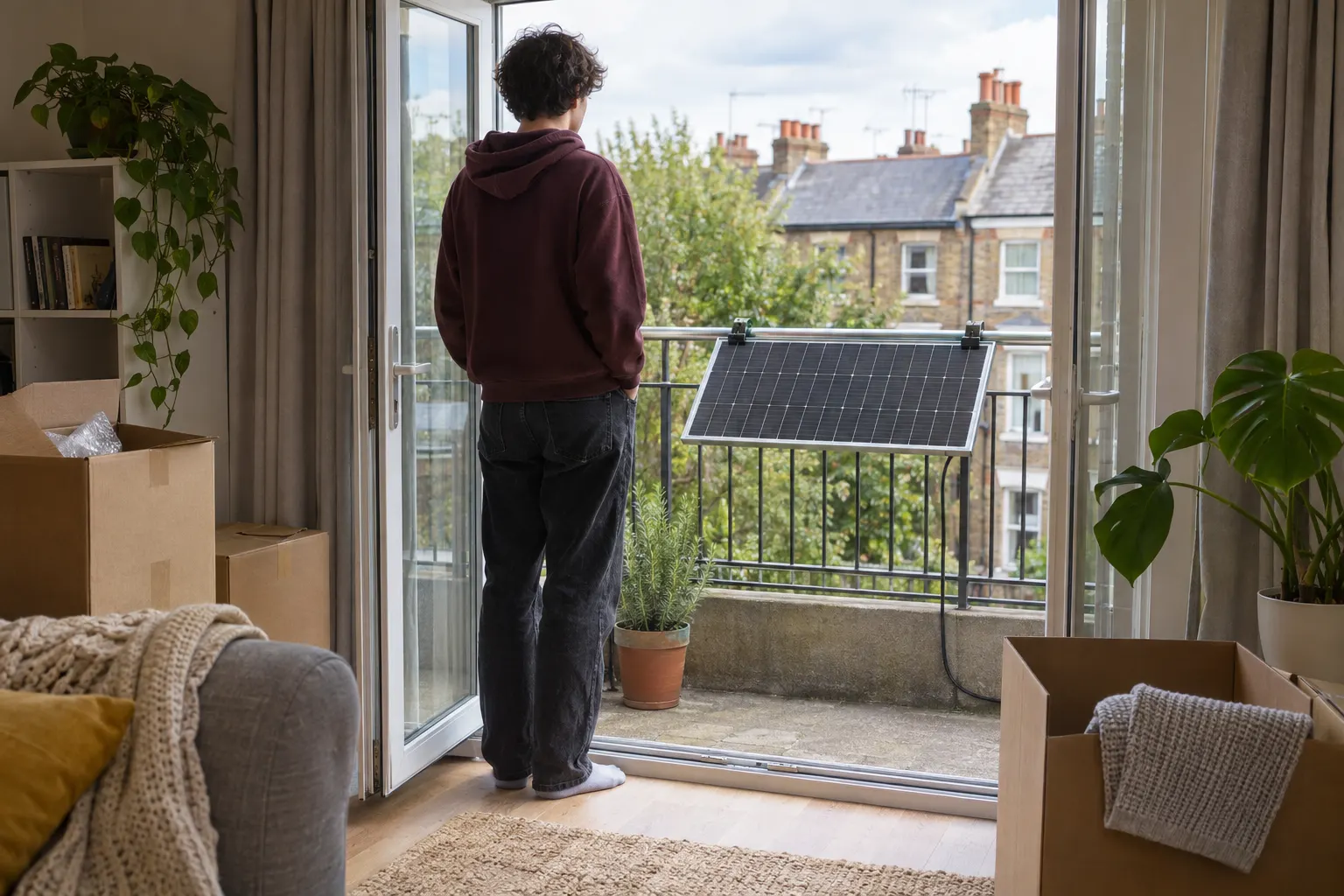
Yes, you can fit a small solar kit to a rented home, but only with permission. Solar panels on flats and rented homes are in the same legal position as anyone else’s since 27 August 2026: plug-in solar is allowed in England, Wales and Scotland. SI 2026/848 reg. 1 What a tenant does not have is a legal right to install one. The decision sits with your landlord, and in a block, often with the freeholder as well. This guide covers who has to say yes, how to ask, and what to do when you leave. For the basics of the kit itself, start with our plug-in solar guide.
The Short Version for Renters
- Plug-in solar is legal in Great Britain Legal
- No law gives a tenant a right to install it
- You need written permission from your landlord, and from the freeholder or managing agent in a block
- The Renters’ Rights Act 2025 does not change that: we found no provision on solar
- Register the device on myplugin.solar before you use it, and notify removal when you leave
- Take the kit with you when you go
Not sure which of this applies to you? Four questions sort it out.
Can I? Four questions
Check what applies to your home
Can You Put Solar Panels on Flats?
It depends on where the panel would go and who owns that part of the building. A plug-in kit is small: one or two panels, a microinverter and a standard plug that goes into a fixed wall socket. It does not need roof work or an installer. That is why it suits flats better than a traditional rooftop system, which would normally need the freeholder’s agreement to alter the roof or structure.
The kit has to be mounted in a way that is reversible and not permanent, which fits a balcony rail, a ground stand or a bracket you can remove cleanly. DESNZ interim product specification v2, §8.3.2, 2026
Balcony, Wall or Flat Roof
In England, the planning change that arrived with the electrical one applies to blocks of flats as well as houses. SI 2026/896, A.1(1) Installation is permitted development, with limits on how far the panels may stick out: 0.2 m from a wall facing a highway and 0.4 m elsewhere. SI 2026/896
There are exceptions. Listed buildings, scheduled monuments and conservation areas (where the wall faces the road) are carved out. If your flat is in one of those, ask the local planning authority before you buy. SI 2026/896
That order changes England’s rules only. For Scotland and Wales we could not confirm an equivalent planning rule, so check with your local planning authority first. Our balcony solar guide looks at the balcony case in more detail.
Planning rules are one layer. Permission to use the building is another. Permitted development tells you the council will not need an application. It does not tell you the landlord or freeholder is happy for you to attach something to their building.
Where It’s Not Allowed
The product specification sets hard limits on where a kit may go. It rules out ACM, MCM and HPL cladding, timber cladding systems and timber balconies, and any building undergoing external wall remediation. DESNZ interim product specification v2, §8.3.2, 2026
The planning order also bars installation on a wall, balcony or fence made of timber. SI 2026/896
In practice, many tenants in newer blocks do not know what their building is clad in. If you do not, ask the managing agent. It is a reasonable question, and the answer decides whether you can proceed at all.
Flat Roofs: Only Plug-In
If you live in a block with a flat roof, treat the roof as the freeholder’s. This guide is about plug-in kits, not a roof array. A plug-in kit is not the same job as a rooftop installation, and it does not turn a shared roof into yours.
Even with a plug-in kit, a roof is the hardest place to get agreement. It is a shared part of the building, access is usually restricted, and the cable has to reach a socket inside your flat. A balcony you have exclusive use of is the easier request. If a roof is your only option, make the request to the freeholder rather than assuming your landlord can grant it.
Renters: Who Has to Say Yes
Three people may have a say. Your landlord, the freeholder if the building has one, and the managing agent acting for the freeholder. They are not always the same person, and the answer from one does not bind the others.
Your Landlord
No law gives tenants a right to install plug-in solar. The product specification makes manufacturers warn users that they are “responsible for obtaining any necessary permissions from the property owner, landlord, freeholder, managing agent or relevant authority prior to installation”. DESNZ interim product specification v2, 2026
The same wording covers how costs are apportioned, so agree that upfront too.
Your tenancy agreement matters. Many ban alterations to the property without consent. Even if a plug-in kit leaves no mark, attaching it to the building is likely to count. Read the clause before you write.
Freeholder and Managing Agent
In a block of flats, your landlord may be a leaseholder who rents out their own flat, or a company. Either way the freeholder usually controls the structure, the external walls, the balconies and the roof. DESNZ says approval decisions are “a matter for landlords, freeholders or councils”. DESNZ news, 26 Aug 2026
DESNZ also encourages them to consider each request on its merits. That is guidance, not a rule that obliges them to say yes. If they refuse, you have no legal route to override it, so a clear request matters.
A practical order of play: ask your landlord first, then ask them to confirm whether the freeholder or managing agent needs to approve as well. If your landlord is reluctant to write to the managing agent, you can offer to send the request yourself with your landlord’s consent attached.
What the Renters’ Rights Act 2025 Says
You may have read that new tenancy law lets renters demand solar panels. We read the Renters’ Rights Act 2025 for a provision on solar and found none. The right to ask for consent that cannot be unreasonably refused relates to pets, not panels. Claims to the contrary that we have seen cite no primary source.
That is a gap, not a ban. It means plug-in solar for renters is a negotiation, not an entitlement.
How to Ask Your Landlord
A good request is short, specific and easy to say yes to. The aim is to take away each reason a landlord might have to refuse. Bring:
- The product sheet. A kit sold in Great Britain should state compliance with the interim product specification. Attach the manufacturer’s product sheet and say the kit is a standard plug-in device with an 800 W AC cap. SI 2026/848 reg. 2(3)
- How it is fixed. Describe the mount and say it is reversible. Say what, if anything, touches the wall or balcony, and what will be left when it comes off.
- Who pays. You pay for the kit and its mount, and you pay to make good any marks when it comes off. Say so.
- The registration. Say that you will register the device on myplugin.solar before you use it, with your name, your postcode and the make and model. Electricity North West, plug-in solar, 2026
- Insurance. Say you will tell your contents insurer, and ask whether the landlord wants to tell the building insurer.
- Removal. Offer to take it down and notify removal when you leave.
Keep it to one page and ask for a written reply. A yes by text message is better than nothing, but an email or signed letter is what you will want to point to later.
A full letter, with wording for the freeholder and a checklist for your insurer, is in the renters’ pack.
Insurance and Deposits
Insurance
The product specification requires the manual to tell you that you are responsible for checking the effect on your own insurance and on the building’s insurance. DESNZ interim product specification v2, §8.3.1, 2026 No rule requires a specific policy. Tell your contents insurer what you plan to fit, and ask the landlord or freeholder to check the building policy. Our landlord and insurance guide goes into the detail.
Deposits
No rule we found sets out what a landlord can deduct for a plug-in kit. Our advice is editorial: agree in writing, before you install, how the wall, balcony or fence will be left. If the landlord wants a photo record before and after, take one. A written agreement and dated photos make it much harder for a mark to be disputed at the end of the tenancy.
Moving Out
Removal has to be notified to the network operator as well as installation. Ofgem decision DCRP/MP/26/02, 2026
A tidy move-out looks like this:
- Notify your network operator that the device has been removed.
- Take down the panels, the mount and the cable, and put the wall, balcony or fence back as you found it.
- Tell your landlord, and the freeholder if they approved it, that it is done.
- Take the kit with you. A plug-in kit works wherever there is sun and a fixed socket, so it can go to your next home, subject to that landlord’s permission.
If you plan to move within a year or two, that portability is a point in your favour when you ask. The landlord is not being asked to accept a permanent change.
Leaseholders Who Own Their Flat
If you own your flat on a lease, you are not a tenant, but you are not free of permissions either. The lease and the freeholder control the exterior, the balcony and the roof. The product specification names the freeholder and managing agent among those whose permission you must obtain. DESNZ interim product specification v2, 2026
Read your lease for the clauses on alterations, the exterior and the balcony. Then write to the freeholder or managing agent with the same package you would give a landlord: product sheet, mounting, who pays, registration and removal. In England, permitted development removes the planning application, but it does not remove the lease. SI 2026/896
If your building has external wall remediation under way, or is clad in a material the specification excludes, a plug-in kit is not an option for now. Revisit it when the work is complete.
For the full rules behind all of this, including the points where official documents disagree, see Is plug-in solar legal in the UK?
Sources
Each one opened and checked on 10 November 2026.
- SI 2026/848, the Plugs and Sockets etc. (Safety) and ESQCR (Amendment) Regulations 2026
- SI 2026/896, permitted development for plug-in solar (England)
- DESNZ, Plug-in Solar Device Interim Product Specification v2 (16 July 2026)
- DESNZ news, 26 August 2026: plug-in solar panels come to market
- Electricity North West, plug-in solar (register on myplugin.solar)
- Ofgem, decision on DCRP/MP/26/02 (G98 for plug-in microgeneration)
Questions people ask
Can tenants get solar panels?
Yes, with written permission. Plug-in solar is legal in Great Britain, but no law gives a tenant the right to install it. The product specification puts the duty on the user to obtain consent from the landlord, freeholder or managing agent first. Many tenants will find a reversible balcony or ground mount easier to agree than a roof system.
Do tenants benefit from solar panels?
Tenants who pay their own electricity bills benefit most, because the kit reduces what they draw from the grid in daylight. The saving is modest and depends on sun, shade and daytime use. Because a plug-in kit can be taken down and moved, the investment is not stranded when you leave.
Can solar panels be installed on a flat roof?
A flat roof of a block belongs to the freeholder, so you need their permission first. A plug-in kit is a different job from a roof installation: it must be reversible and not permanent. Ask the freeholder or managing agent before you plan anything, and check what the building is clad in.
Do solar panels work on cloudy days?
Yes, but they make less. Panels respond to daylight, not just direct sun, so a plug-in kit still produces on an overcast day, at a lower level than in clear weather. Shade from a wall, tree or neighbouring building usually costs more output than cloud does, so check the spot before you buy.
Can my landlord refuse plug-in solar?
Yes. DESNZ says decisions on whether to approve requests are a matter for landlords, freeholders or councils, and no law forces a landlord to agree. They should consider each request on its merits, so a clear, reversible, written proposal gives you the best chance.