
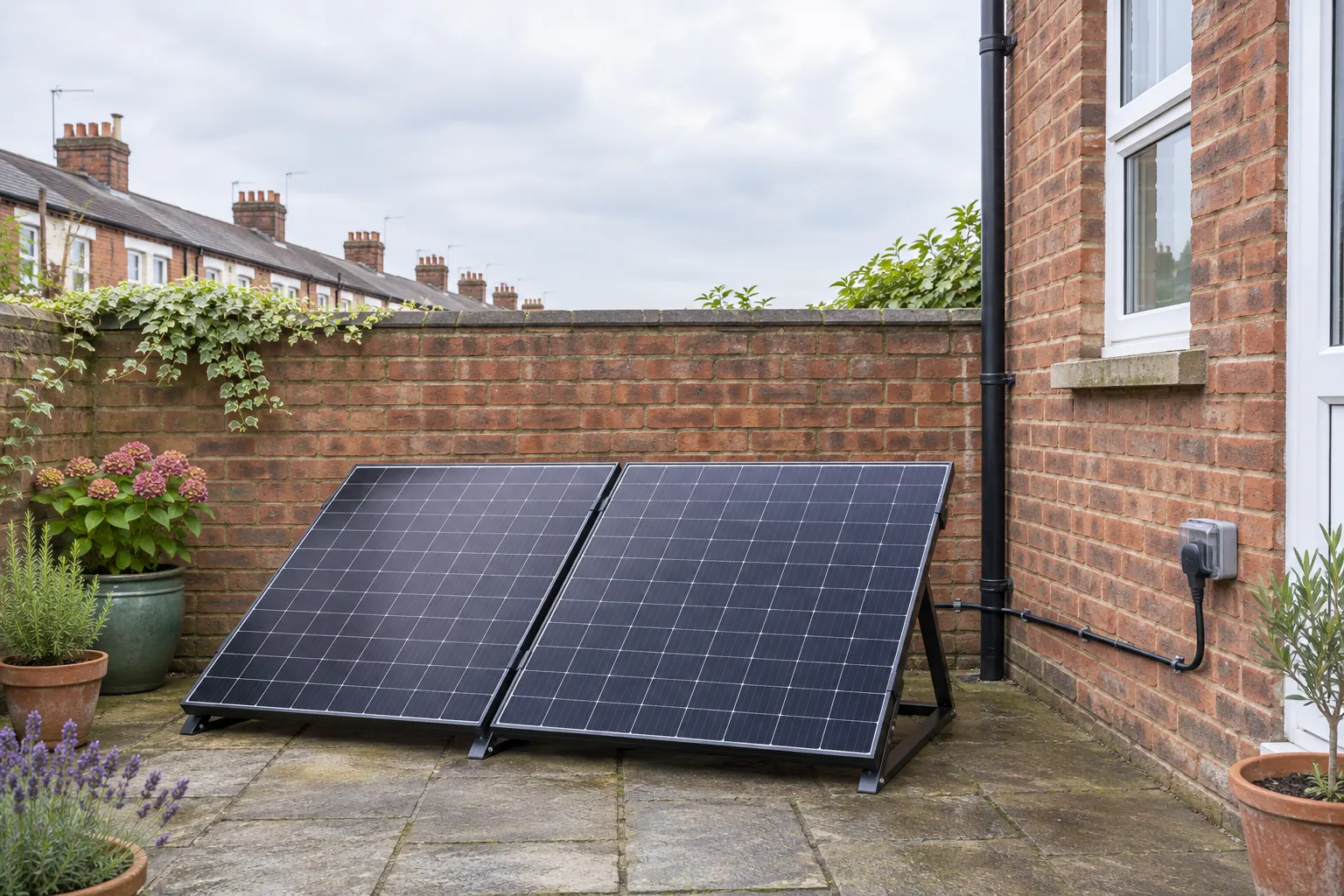
Plug in solar is a small solar kit you connect to a normal wall socket: one or two panels, a microinverter and a standard three-pin plug. Since 27 August 2026 it has been legal in England, Wales and Scotland. SI 2026/848 reg. 1 The output is capped at 800 W AC SI 2026/848 reg. 2(3), you can have one per home, and tenants need their landlord’s consent. This guide shows each rule with its source and the date we checked it.
The Short Version
- Legal in Great Britain since 27 August 2026 Legal
- Northern Ireland: the change does not reach it in practice No law yet
- Batteries inside the plug-in unit Not allowed
- One device per home
- Register it on myplugin.solar before you use it
Not sure where you stand? Four questions tell you which of the rules below apply to your home.
Can I? Four questions
Check what applies to your home
What Is Plug-In Solar and How Does It Work?
Think of it as the smallest legal solar system you can own. There is no roof work, no scaffolding and no installer visit. You mount the panels, run the cable to a socket and plug in. The kit then feeds electricity into your home’s wiring, and anything already running in the house uses that power first.
The Three Parts
- 1
Panels
Up to 2,000 W of DC
- 2
Microinverter
Caps output at 800 W AC
- 3
Three-pin plug
BS 1363, no adaptor
- 4
Your home
Appliances use the power first
A plug in solar system has three parts. The panel (or panels) turn light into direct current. The microinverter converts that to the alternating current your home uses and switches itself off if the grid goes down. The plug is an ordinary BS 1363 three-pin plug, approved by a notified body, and it goes into a fixed BS 1363-2 socket. There is no special plug: the law relies on the plug you already know. SI 2026/848 reg. 2(2) and 3(3)
The kit must meet the Plug-in Solar Device Interim Product Specification, version 2, published by DESNZ on 16 July 2026. DESNZ interim product specification v2, 2026 Look for a statement of compliance on the box or the listing.
800 W AC, Up to 2,000 W of Panels
Two numbers matter. The inverter may put out no more than 800 W of alternating current. The panels connected to it can add up to 2,000 W of direct current. SI 2026/848 EM §5.1 The law counts watts, not volt-amperes. The product specification talks about 800 VA of apparent power, but the regulations themselves say 800 watts, so that is the figure to use when you compare products.
In plain terms: whatever the panels could theoretically make, the amount going into your home is capped at 800 W.
What 800 W Runs in Practice
Plug-in solar suits the steady, always-on part of your daytime electricity use. DESNZ describes a kit running a typical fridge, television, Wi-Fi router, laptop, phone charger and an Xbox S at the same time when the sun is shining. DESNZ news, 26 Aug 2026
When the kit makes more than the house is using, the surplus flows out to the grid and you are not paid for it by default (more on that below). That is why homes with someone in during the day tend to get more from a kit than homes that are empty from 8 to 6. For a figure based on your own postcode, orientation and tariff, use our calculator rather than a rule of thumb.
Is Plug-In Solar Legal in the UK?
This is a summary. The full rules, the sources and the points that are still unclear live on our dedicated legal page, Is plug-in solar legal in the UK?
Great Britain Yes, Northern Ireland Not Yet Covered
The Plugs and Sockets etc. (Safety) Regulations 1994 and Electricity Safety, Quality and Continuity Regulations 2002 (Amendment) Regulations 2026, SI 2026/848, came into force on 27 August 2026. The permission to use a plug-in kit applies in England, Wales and Scotland. SI 2026/848 reg. 1
Northern Ireland is a different story. Regulation 3, the one that allows use, does not extend there, and the product specification says application to Northern Ireland is subject to further consideration. SI 2026/848 reg. 1(3)-(4) We could not confirm a decision by the Department for the Economy. Until one appears, do not assume a kit is allowed there. That is not the same as saying it is banned: we have simply found no rule that covers it.
The Six Rules in Plain English
- Buy a compliant product. It must meet the interim product specification v2. SI 2026/848 reg. 2(2)
- Use a fixed wall socket. Never an extension lead, multi-way adaptor, RCD adaptor or travel adaptor. Ofgem decision DCRP/MP/26/02, 2026
- One per home. The specification says one per final circuit, but Ofgem approved a G98 change that limits it to one per installation, and the tighter limit applies. Ofgem decision DCRP/MP/26/02, 2026
- Register it before you use it. You register the device on myplugin.solar, and removal must be notified too. Electricity North West, plug-in solar, 2026
- No battery in the plug-in unit. A plug-in device with a battery is still not permitted. SI 2026/848 reg. 2(3)(e)
- You can install it yourself. Ofgem’s decision exempts the consumer from needing a competent installer. Ofgem decision DCRP/MP/26/02, 2026
For the sources in full and the points where official documents disagree, read the full legal guide.
What Plug-In Solar Panels Cost and Save
Plug in solar panels for home use sit at the cheap end of solar, but the honest question is what you get back.
Savings
On 26 August 2026 DESNZ said households could save up to £110 a year, and that a kit could provide up to 20% of an average home’s electricity use. DESNZ news, 26 Aug 2026 Read both as ceilings. They describe a good case, not the typical one. A shaded, north-facing spot in an empty house will land well below them.
What moves your number: how much sun reaches the panel, how much of your daytime use is steady (fridge, router, standby), and your unit rate. Our calculator takes those inputs rather than guessing.
Export Is Not Paid by Default
The Smart Export Guarantee (SEG) pays for electricity you send to the grid, but it requires an installation by an MCS-certified installer using certified products. MCS, SEG for consumers, 2026 MCS says plug-in solar, as a do-it-yourself system, is outside the scope of MCS. MCS, 14 Sep 2026 That leaves no documented route to SEG payments today. We could not find an Ofgem or DESNZ source that creates one.
Some sellers describe their kits as MCS accredited. MCS itself says plug-in solar is outside its scheme, so treat that claim with caution and ask the seller for the certificate.
Kit Prices
Prices move quickly in a new market, so we do not print them in the text. Our comparison table shows prices read from the brand’s own store, with the date we read them. See best plug-in solar kits.
Payback
Payback depends entirely on what you pay, what you use in daylight and where you mount the panels. We do not give a single number here, because any one number would be wrong for most households. Try the plug-in solar calculator for your own case.
Plug-In Solar for Renters and Flats
This is where most guides stop, and where most people have questions. If you rent or live in a flat, the rules are the same but the permissions are not.
You Need Your Landlord’s Permission
No law gives tenants a right to install plug-in solar. The product specification makes manufacturers warn users that they are “responsible for obtaining any necessary permissions from the property owner, landlord, freeholder, managing agent or relevant authority prior to installation”. DESNZ interim product specification v2, 2026
DESNZ says decisions on whether to approve requests are “a matter for landlords, freeholders or councils”, and encourages them to consider each case on its merits. DESNZ news, 26 Aug 2026 In practice that means a written request, a clear description of the kit, and an offer to remove it when you leave. Our renters guide covers the approach in detail.
Flats: Freeholder, Managing Agent and Cladding
In England, the planning change that came with the electrical one applies to blocks of flats as well as houses. SI 2026/896 That helps, but it does not replace the freeholder or managing agent: they still control the building’s structure and shared parts.
There are hard limits on where a kit may go. The product specification rules out ACM, MCM, HPL and timber cladding systems, timber balconies, and any building undergoing external wall remediation. DESNZ interim product specification v2, §8.3.2, 2026 If you do not know what your building is clad in, ask before you buy.
What the Renters’ Rights Act 2025 Says
You may have seen claims that new tenancy law lets renters demand solar panels. We read the Renters’ Rights Act 2025 for a provision on solar and found none. The right to ask for consent that cannot be unreasonably refused relates to pets, not panels. Claims to the contrary that we have seen cite no primary source.
Insurance
The product specification requires the manual to tell you that you are responsible for checking the effect on your own insurance and on the building’s insurance. DESNZ interim product specification v2, §8.3.1, 2026 No rule requires a specific policy. Tell your contents insurer, and ask the freeholder about the building policy. Our landlord and insurance guide will go deeper on this.
How to Set Up Plug-In Solar, Step by Step
Check the Socket and the Circuit
Your home’s fixed wiring is still covered by BS 7671:2018+A4:2026. If you have no modern RCBO protection or still have old fuses, an electrician should check the circuit before you plug in. DESNZ interim product specification v2, §8.3.2; Ofgem decision, 2026 Any change to the circuit is electrician’s work. Plugging in is not.
Use the socket as it is. No extension, no multi-way block, no adaptor of any kind.
Mount It Safely
The mounting must be reversible and not permanent. DESNZ interim product specification v2, §8.3.2, 2026 Ground frames, balcony rails and fence brackets all qualify if they meet that test and the panel is secure in wind.
In England, planning permission is not normally needed: SI 2026/896 made installation permitted development from 27 August 2026, as long as the panels stick out no more than 0.2 m from the wall facing a highway and 0.4 m elsewhere. There are exceptions for listed buildings, scheduled monuments and conservation areas where the wall faces the road, and it is not allowed on a wall, balcony or fence made of timber. SI 2026/896
That order amends England’s rules only. For Scotland and Wales we could not confirm an equivalent planning rule, so check with your local planning authority first.
Register Before You Plug In
Register the device before you use it. A compliant plug-in solar device (solar only, 800 W AC at most, listed on the ENA type test register) is not notified with a G98 Form B. You register it on the UK plug-in solar website, myplugin.solar, with your name, your postcode and the make and model. Electricity North West, plug-in solar, 2026 The law says the network operator must be advised before, or at the time of, commissioning, so there is no 28-day grace period after you plug in. ESQCR 2002 reg. 22(2)(c)
Check the model on the ENA Connect Direct type test register first, and find your network operator with the ENA’s Who’s my network operator? postcode tool. G98 still applies to hard-wired installs and larger generation.
When You Move Out
Removal has to be notified too. Take the kit down, reinstate the wall, balcony or fence as you found it, and if you rent, tell your landlord it is done.
How to Choose a Plug-In Solar Kit
Four checks cover most of it:
- 800 W AC at most. Anything higher is outside the rule.
- Complies with the interim product specification v2. The seller should say so plainly.
- A standard BS 1363 plug. No special connector, no adaptor in the box.
- No built-in battery. A plug-in device with a battery is not permitted. A separate battery is a different product with its own rules, covered in our battery guide.
When a plug in solar system lists several panel bundles, compare the inverter rating first, because it is the inverter that sets the 800 W limit.
Downsides and Limits
Plug-in solar is useful, but it is not a replacement for a roof system. These are the limits to know before you buy:
- The 800 W ceiling. A bigger array does not push more into your home.
- Export is not paid. Surplus goes to the grid without a payment route today.
- Shade and orientation. A kit in the shade of a wall or tree makes little.
- One per home. You cannot add a second kit to the same installation.
- Northern Ireland. The change does not reach it in practice.
- Permissions when renting. Your landlord or freeholder can say no, and no law gives you a right to install.
- No battery. A unit with a battery inside is still not permitted.
If you rent, start with the checker above and our renters pack. If you own, start with the registration and the socket check. Either way, a plug-in solar UK setup is cheap to try and easy to remove, which is its main appeal.
Sources
Each one opened and checked on 10 November 2026.
- SI 2026/848, the Plugs and Sockets etc. (Safety) and ESQCR (Amendment) Regulations 2026
- SI 2026/848, Explanatory Memorandum
- DESNZ, Plug-in Solar Device Interim Product Specification v2 (16 July 2026)
- Electricity North West, plug-in solar (register on myplugin.solar)
- ESQCR 2002, regulation 22 (as amended by SI 2026/848)
- Ofgem, decision on DCRP/MP/26/02 (G98 for plug-in microgeneration)
- SI 2026/896, permitted development for plug-in solar (England)
- DESNZ news, 26 August 2026: plug-in solar panels come to market
- MCS, response on plug-in solar (14 September 2026)
- MCS, Smart Export Guarantee for consumers
Questions people ask
Is there such a thing as plug-in solar?
Yes. Plug-in solar is a small solar kit that connects to a normal wall socket through a standard three-pin plug. It has been legal to buy and use across Great Britain since 27 August 2026. Kits are limited to 800 W of AC output and must meet the government's interim product specification.
Are plug-in solar panels any good?
They are good at one job: covering the electricity your home is already using while the sun shines, such as a fridge, router and standby loads. They will not run a whole house and they do not earn export payments by default. Savings depend on your sun, shade and daytime use.
Do I still pay for electricity if I have solar panels in the UK?
Yes. Solar only covers what you use while it is generating. At night, on dull days and whenever your home needs more than the kit produces, you still draw from the grid and pay your supplier, including the standing charge. A plug-in kit reduces your bill; it does not replace it.
How much could you save with plug-in solar panels?
The Department for Energy Security and Net Zero (DESNZ) said on 26 August 2026 that households could save up to £110 a year. That is a ceiling, not an average. Your own figure depends on roof or garden orientation, shade and how much electricity you use in daylight hours.
Who is selling plug-in solar panels in the UK?
DESNZ named Currys, B&Q, Screwfix and Amazon as retailers that worked with government on the rollout, and said Argos and Wickes have committed to stocking them. Availability varies by shop and online. Check that any kit states compliance with the interim product specification before you buy.
Are plug-in solar panels allowed in Ireland?
Not in Northern Ireland, as far as we could confirm. The 2026 change covers England, Wales and Scotland only, and the government says Northern Ireland is subject to further consideration. We could not confirm a decision by the Department for the Economy. The Republic of Ireland is outside this guide and not verified.
Are plug-in solar panels safe?
Compliant kits are designed to be. DESNZ says the legal change followed independent safety testing of all key electrical elements. Safety also depends on how you use it: a fixed socket in good condition, no extension leads, no adapters, and a kit that meets the product specification.
Can I use an extension lead with plug-in solar?
No. The rules say the kit must go into a fixed wall socket, never an extension lead, multi-way adaptor, RCD adaptor or travel adaptor. If the socket is awkward to reach, ask an electrician to add one in the right place rather than extending the cable.