
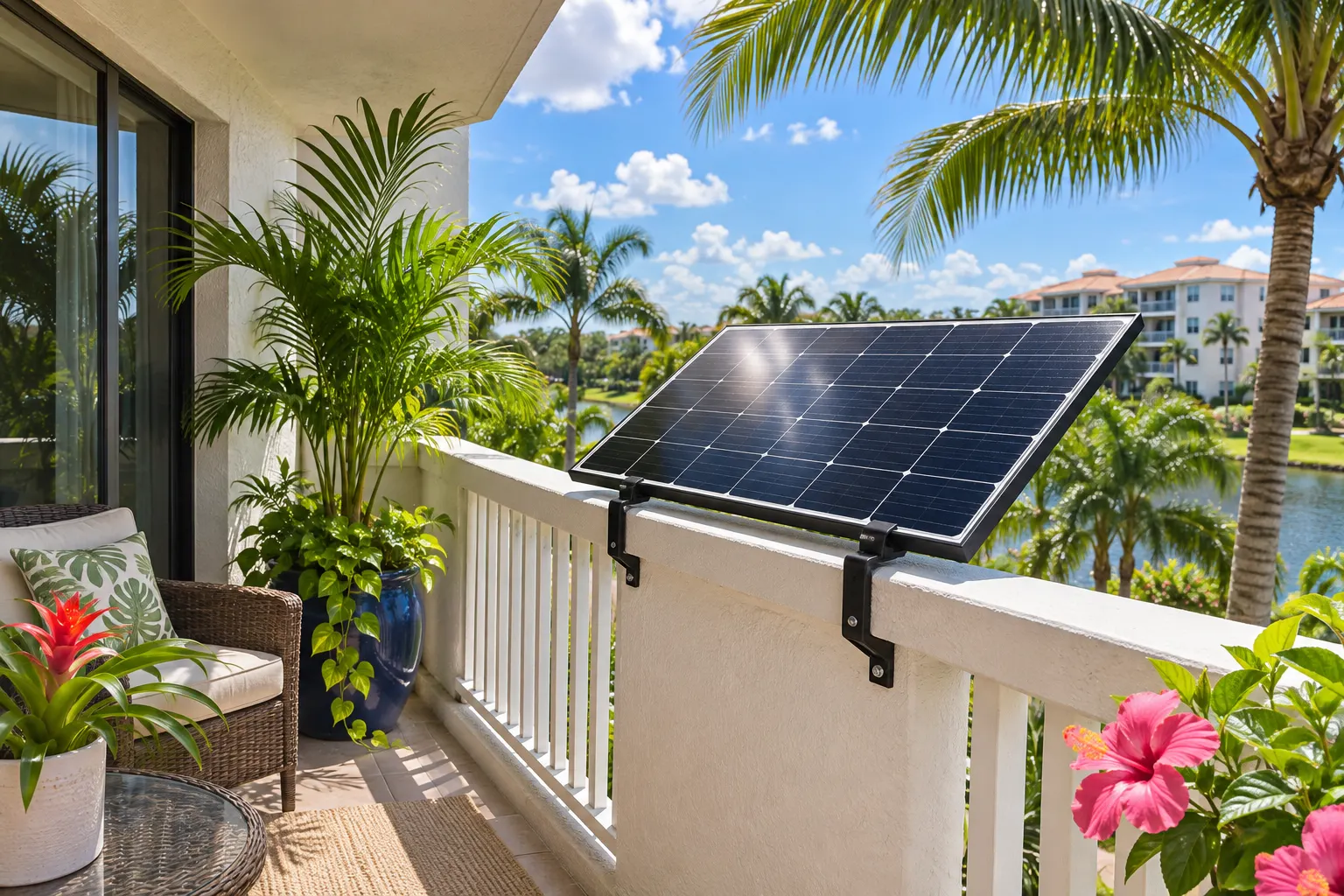
Plug in solar Florida: the short answer is that the state has no plug-in solar law yet. No state law yet That is not the same as banned. It means no Florida statute sets a wattage cap, a plug rule or a right for renters, so the rules that already exist apply: your utility’s interconnection process, the electrical code, and your lease or condo documents. This inference is ours, drawn from the fact that every state with a law exempts plug-in kits from interconnection requirements. We could not verify it utility by utility.
What “No Law” Means in Florida
Ten states have signed plug-in solar laws as of November 9, 2026. Florida is not one of them. Our list covers laws signed up to that date, so a bill still moving through the legislature would not appear in it.
No Federal Rule Either
There is no federal ban and no federal plug-in rule. What governs a kit is the interconnection rule of your own utility and the electrical code your state has adopted.
The Code Does Not Name It
The National Electrical Code has no definition or category for solar that connects through a plug. A proposed amendment to NFPA 70, TIA 1951, says that no definition of a plug-in photovoltaic system exists anywhere in the 2020, 2023 and 2026 editions, and that permit officials have no recognized category to cite. NFPA 70 proposed TIA 1951 It is a proposal, not an adopted rule, and its author is a manufacturer with an interest, so read it as context rather than as law.
What That Leaves You With
Without a state law, there is no promise that your utility will accept a kit without paperwork. Before you buy, ask your utility whether it requires notification or approval for a small plug-in solar system, and keep the answer in writing. Do not assume silence means yes.
Condos and HOAs in Florida
Many Florida homes are condos, and balconies are where plug in solar balcony kits make the most sense. They are also where permission matters most.
We have not confirmed whether Florida’s solar access rules cover plug-in devices, so we do not rely on them here. What we can say is that, in a state with no plug-in law, the condo declaration and the association’s rules are what you are working with.
Questions to Ask the Board
- Do the rules restrict anything attached to a balcony railing or exterior wall?
- Is a small removable panel treated as an alteration of a common element or a limited common element?
- Does the association require written approval, and who signs it?
- Does the building’s insurance policy say anything about attachments or electrical devices?
- Are there rules on appearance, such as color, height or visibility from the street?
Get the Answer in Writing
Send the request by email so you have a record. Describe the kit by brand, size, how it mounts and how it comes off. A removable mount you can take down in minutes is an easier yes than anything drilled into a wall.
Hurricane Season and Balcony Mounting
Florida’s weather is the practical problem a guide written for Germany or the UK does not have to solve. This section is editorial advice, not a code requirement, and we have not cited any building code or wind rating here.
Before a Storm
Take the panel down and store it indoors when a tropical storm or hurricane watch is issued for your area. A panel on a railing can become a projectile, and it can damage your neighbors’ property as well as yours.
Mounting Basics
Use a mount designed for balcony rails, tighten it fully, and add a secondary tether so a loosened panel cannot drop. Check the fixings every few weeks, and after any strong wind or heavy rain. If your condo bans drilling into the structure, a clamp-style mount is the usual route.
Cable and Plug
Keep the cable and plug out of standing water and spray. Run the cable so it does not hang loose in the wind, and plug into a fixed outdoor or indoor socket in good condition, never through an extension cord.
Renters in Florida
If you rent, no state law gives you a right to install plug-in solar, and none that we found blocks it. The deciding document is your lease, plus any rules from the owner or management company. Where the lease is silent, ask anyway: a written yes protects your deposit.
In practice, a good request names the kit, says how it mounts and how it comes off, offers to restore the wall or railing, and states that you will remove it when you move out. Our renters pack includes a ready-to-send letter for that, written for US tenants.
For the wider picture on renting and apartments, see solar for renters and apartments and our guide to landlords and HOAs.
What Other States Allow
Ten states have signed plug-in solar laws, and they show what Florida could adopt. The details below are from the signed texts we read.
- Utah has the oldest law: 1,200 W, a standard 120 V outlet, no utility approval and no fee. Utah HB 340, 2026
- Virginia allows up to 1,200 W from January 1, 2027, with notice to the utility before you install. Va. Code § 56-596.8, 2026
- Colorado allows one system per home, and its law has separate rules for landlords and condo associations. Colorado HB26-1007, 2026
- Maryland allows up to 1,200 W, with notice to the utility before you install. Maryland HB 1532, Chapter 353, 2026
- Connecticut allows up to 1,200 W and keeps local codes in force. Connecticut Public Act 26-127, 2026
Several of these were signed in 2026, and the rules differ on wattage, notice and certification. See the state-by-state hub and our overview of whether plug-in solar is legal in the US for the full table and what we could not confirm.
What You Can Do Now
- Ask your utility in writing whether it requires notice or approval for a small plug-in solar system.
- Read your lease or condo documents, and ask the landlord or board for written permission.
- Choose a kit with a recognised safety certification and no built-in battery, and a mount that comes off.
- Plan to take it down before storms.
Florida may pass a law later. Until then, the sensible approach is the one this guide describes: ask first, keep it removable and keep the answers in writing.
Sources
Each one opened and checked on November 9, 2026.
Questions people ask
Can renters use plug-in solar in Florida?
Florida has no plug-in solar law, so nothing gives a tenant a right to install one and nothing we found bans it. What decides it is your lease and your landlord. Ask in writing, describe the kit, and offer to remove it when you leave. Your utility's interconnection process may also apply.
Are there solar panels for apartments in Florida?
Yes, in the sense that small plug-in style panels exist for balconies and patios. Florida has no law that sets rules for them, so approval comes from your lease, your condo or apartment management, and your utility's interconnection requirements. We could not confirm utility by utility, so ask yours first.
Can my HOA stop me using a balcony solar panel?
In Florida, probably yes, if your governing documents restrict it. We found no Florida plug-in law that overrides condo or HOA rules, and we have not confirmed whether Florida's solar access rules cover plug-in devices. Read your declaration and rules, then ask the board in writing before you buy.