
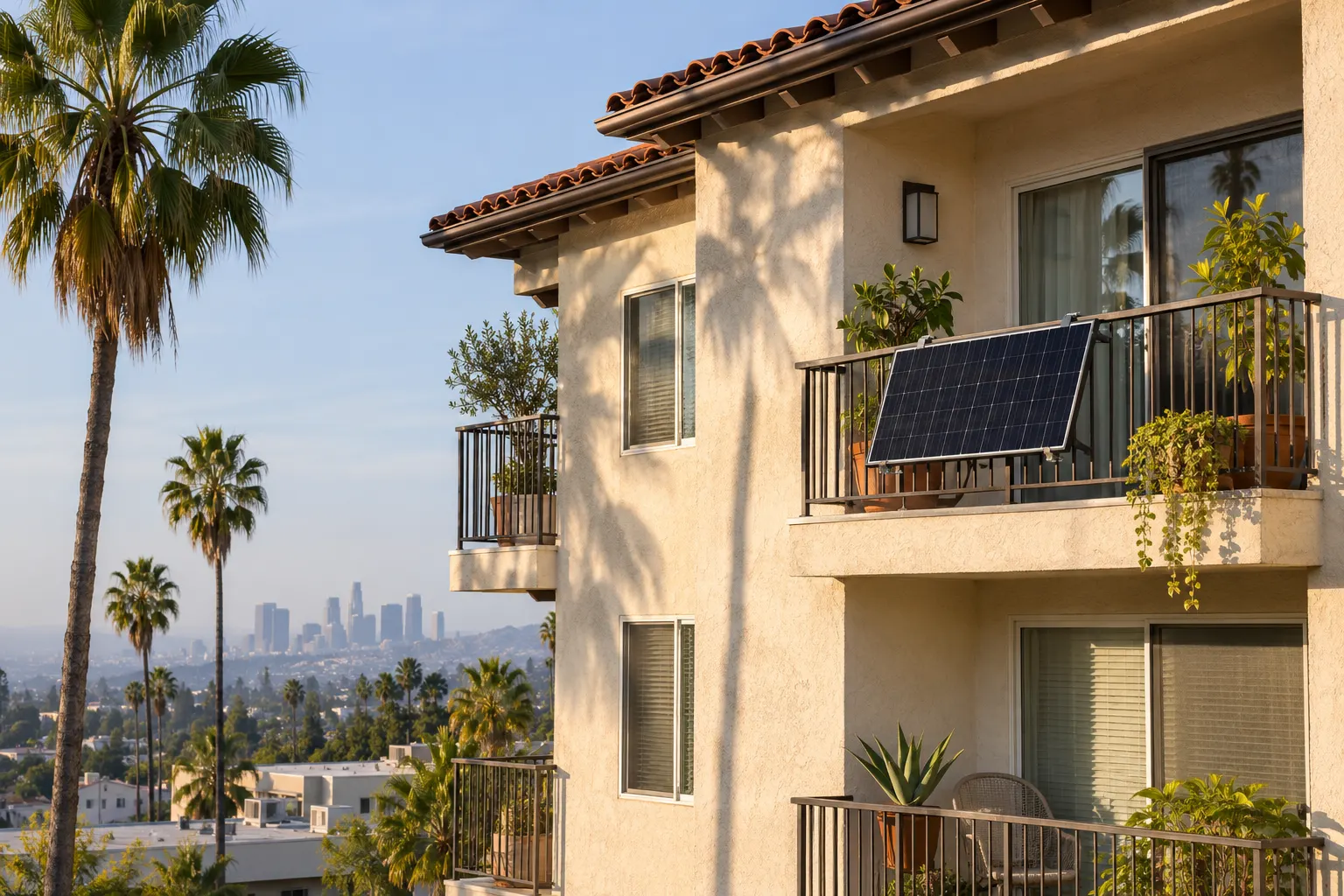
Plug in solar California rules arrive on January 1, 2027. SB 868, signed on September 30, 2026, allows a plug-in solar system of up to 1,200 W AC per home, as long as it is certified and has anti-backfeed protection. SB 868, Stats. 2026 ch. 985 Your utility can ask you to register it online, but it cannot make you wait for approval. This guide takes each rule from the bill text, shows the date we checked it, and says plainly what the law does not cover.
The Short Version
- SB 868 signed by the Governor on September 30, 2026 Signed, in force Jan 1, 2027
- Up to 1,200 W AC per home
- Certified plug-in PV system with certified anti-backfeed isolation
- Utility may ask for a simple online registration, not an approval
- Landlords and HOAs: nothing in the bill, so your lease and bylaws decide
What SB 868 Allows
SB 868 is Statutes of 2026, chapter 985. It adds Public Utilities Code sections 8530 to 8532 and covers small plug-in solar systems in homes. SB 868, Stats. 2026 ch. 985 The Governor approved it on September 30, 2026, and the general rule takes effect on January 1, 2027.
A plug-in solar system is a small kit: one or more panels, a microinverter and a cord that goes into a normal outlet. If you are new to the idea, our plug-in solar guide explains how the parts fit together. This page sticks to what California has decided.
1,200 W per Home
The cap is a maximum aggregated AC output of no more than 1,200 watts per dwelling. SB 868, Stats. 2026 ch. 985 Three words in that sentence matter.
- AC. The limit applies to the alternating current the system puts into your home, which is set by the microinverter. Panel wattage on the roof or rail is a different number.
- Aggregated. If you run more than one unit, their outputs are added together and the total has to stay at or under 1,200 W.
- Per dwelling. The cap belongs to the home, not to each outlet. An apartment and a house each get their own 1,200 W.
For scale, 1,200 W is the most the system can send into the home at any moment. Most households will use far less than that at midday, so the practical question is how much of your daytime use a kit can cover. Our kit comparison lists the AC output of each model.
Certification and Anti-Backfeed
The bill ties the system to the National Electrical Code and the California Electrical Code. It also requires that the system be certified as a plug-in photovoltaic system by UL or another nationally recognized testing laboratory (NRTL), and that the isolation device that prevents backfeed be certified. SB 868, Stats. 2026 ch. 985
Backfeed protection matters because a solar unit must switch off when the grid goes down, so that nobody working on the lines meets power coming back from a home. A certified plug-in system is built to do that on its own.
What this means when you shop: look for a clear statement of the certification on the box and the listing, naming the lab. A product that only says “UL listed components” is not the same as a certified plug-in system. If a seller cannot show the certificate, ask for it before you pay.
Utility Registration (Not Approval)
Your utility may require you to register the system through a simple online process. The information in scope is your address, the make and model of the equipment, and its wattage. The bill does not allow the utility to require approval. SB 868, Stats. 2026 ch. 985
Two cautions. First, the word is “may”: each utility decides whether it runs a registration page and what it looks like, and we have not seen any of those pages yet. Second, registration is about telling the utility the system exists. It is not a permit, an inspection or a fee, as far as the bill text goes.
Before January 1, 2027: What Applies Until Then
If you are reading this in late 2026, the new rules are signed but not yet general law. We found no source that says buying or using a plug-in system today is a crime, and we will not say it is. What we can say is that until the new rules start, your utility’s interconnection process applies.
That is our reading, not a quote from SB 868: every state with a plug-in law exempts these systems from normal interconnection steps, which suggests those steps apply where no such law exists. We have not checked it utility by utility. If you want to run a system before January, ask your utility in writing what it requires, and keep the reply.
Practical advice for the wait:
- Do not buy a kit that exceeds 1,200 W AC on the assumption that you can fix it later.
- Buy a model that states its certification, because that is what the law will ask for.
- Check your utility’s website in January for its registration page.
The 2030 Deadline for Products
SB 868 gives some products a transition. The exemptions in the bill expire on January 1, 2030, and from that date a plug-in device that does not meet conditions (4) to (6) of section 8530 may not be sold or offered for sale in California. SB 868, Pub. Util. Code 8531(e) and 8532, 2026
Those three conditions are the ones described above: the device meets the National Electrical Code and the California Electrical Code, it is certified as a plug-in photovoltaic system by UL or an equivalent NRTL, and it has a certified feature that isolates it from the building’s wiring so it cannot backfeed the grid in an outage.
What it means for you today, in plain terms:
- If you buy a certified kit now, you are buying the kind of product the law is built around. The 2030 cut-off is aimed at sellers, not at people who already own a system.
- If you are offered a cheap uncertified kit, the risk is not only safety. It may not qualify under the rules that start in 2027, and by 2030 it may not be legal to sell at all.
- If you are a seller, plan for the 2030 date now.
Renters, Condos and HOAs in California
SB 868 says nothing about landlords or homeowners associations. We found no landlord or HOA provision in the text. So there is no law we can point to that gives a California tenant the right to install a plug-in system, and none that lets a landlord say no.
We also did not verify any general California solar-access statute that might apply to a plug-in system, so we are not citing one. If someone tells you a specific Civil Code section guarantees your right, ask for the section number and read it yourself.
What Decides It: Your Lease and Your Bylaws
In practice, two documents decide:
- Your lease. Look for clauses on alterations, balconies, exterior walls and electrical changes. A kit that hangs on a rail and plugs into an indoor outlet may still count as an alteration to your landlord.
- Condo or HOA rules. Balconies and exterior walls are often common property or have appearance rules. Read the declaration and bylaws, and ask the board.
Other states have gone further. Colorado, New Jersey and Vermont wrote tenant or HOA rules into their plug-in laws, and our landlord and HOA guide compares them. California has not, as far as the text shows.
Asking for Permission
A written request works better than a casual question. Say what the system is, give the model and its certification, state that it is under 1,200 W AC, and say you will remove it and repair any marks when you move out. Offer to share the manual. Keep the answer in writing.
Our renters pack includes a landlord letter written for this, along with a short note for your insurer. For a wider look at apartments, see plug-in solar for renters and apartments.
Choosing a Kit for California
Four checks cover most of it:
- 1,200 W AC at most, in total. If you plan more than one unit, add the AC outputs.
- Certified as a plug-in PV system by UL or another NRTL, with the lab named.
- Certified anti-backfeed isolation. Ask for it by name.
- A standard outlet connection. No special wiring, no work inside the panel.
Compare the inverter rating first, because it sets the AC limit. Panel wattage is a separate number, and a large array on a small inverter still puts out no more than the inverter allows.
Space and light matter as much as the law. A balcony facing south with no shade will beat a shaded one facing north, whatever the label says. Our best plug-in solar kits page lists each kit’s AC output and certification, with the date we checked it.
What We Could Not Confirm
- The official legislature page blocked our automated access, so the text we used is a mirror of the chaptered bill. We rechecked the key facts against the official page by hand on November 9, 2026: the chapter number, the September 30, 2026 approval, the 1,200 W AC cap and the 2030 expiry of the exemptions.
- We have not seen any California utility’s registration page yet.
- We found no source that says what happens to systems bought before January 1, 2027.
When any of these changes, we update this page and the date at the top.
Sources
Each one opened and checked on November 9, 2026.
Questions people ask
Is it mandatory to get solar panels in California?
SB 868 does not require anyone to install plug-in solar. It is a permission law: it sets the conditions under which a small plug-in system of up to 1,200 W AC per home can be used. Whether solar is required on new construction is a separate question that this guide does not cover.
Are plug-in solar panels any good?
They are good at covering the steady electricity your home already uses while the sun shines, such as a fridge, router and standby loads. They will not run a whole home. Under SB 868 a system is capped at 1,200 W AC per dwelling, and what you save depends on sun, shade and daytime use.
Can renters in California use plug-in solar?
SB 868 has no rule on landlords or homeowners associations, so we found no legal right for a tenant to install one. Your lease and, in a condo, the HOA rules decide. Ask for written consent first and offer to remove the system when you leave.
Will my utility have to approve it?
No. As we read SB 868, the utility may ask you to register the system online with your address, the make and model and the wattage, but it cannot make you wait for approval. Registration is a notice, not a permission. Check your own utility's page after January 1, 2027.